
White Hair: Causes, Risk Factors and How to Manage Premature Graying
Finding your first white hair can be surprising.
For some people, it happens naturally with age. However, others may notice white or grey hairs while they are still young. When this happens, many people immediately ask the same questions.
Why is my hair turning white?
Can stress cause white hair?
Is it related to vitamin deficiency?
Can white hair turn black again?
These are reasonable questions. After all, your hair is an important part of your appearance. Therefore, an early change in hair colour can affect confidence, self-image and even how you feel in social or professional situations.
The good news is that white hair does not automatically mean that something is seriously wrong with your health. In many cases, genetics plays the biggest role. Nevertheless, certain nutritional deficiencies, medical conditions and lifestyle factors may also be associated with premature graying.
At Interclinic Medicine & Surgery Clinic, we take a broader approach. Rather than simply looking at the colour of your hair, we consider your overall health, family history, lifestyle, nutrition and scalp condition.
This guide explains what causes white hair, when it may be considered premature, and what you can realistically do about it.
What Is White Hair?
Your natural hair colour comes from a pigment called melanin.
Melanin is produced by specialised cells called melanocytes. These cells are located inside your hair follicles. As a new hair grows, melanin is incorporated into the developing hair shaft.
The amount and type of melanin determine whether your hair appears black, brown, blonde or red.
As pigment production decreases, the hair may first appear grey. Eventually, it may appear completely white when very little or no pigment is incorporated into the hair shaft.
Therefore, white hair is essentially hair with little or no visible melanin.
The process does not mean that the hair itself is unhealthy or dead. Instead, it reflects a change in the pigment-producing system within the follicle.
Importantly, this distinction helps explain why cutting or shaving white hair does not make it grow back darker. The colour is determined inside the follicle while the new hair is developing.
When Is White Hair Considered Premature?
Not everyone develops white hair at the same age.
Genetics has a major influence on when your hair begins to lose its pigment. Ethnic background also appears to influence the typical timing of premature graying.
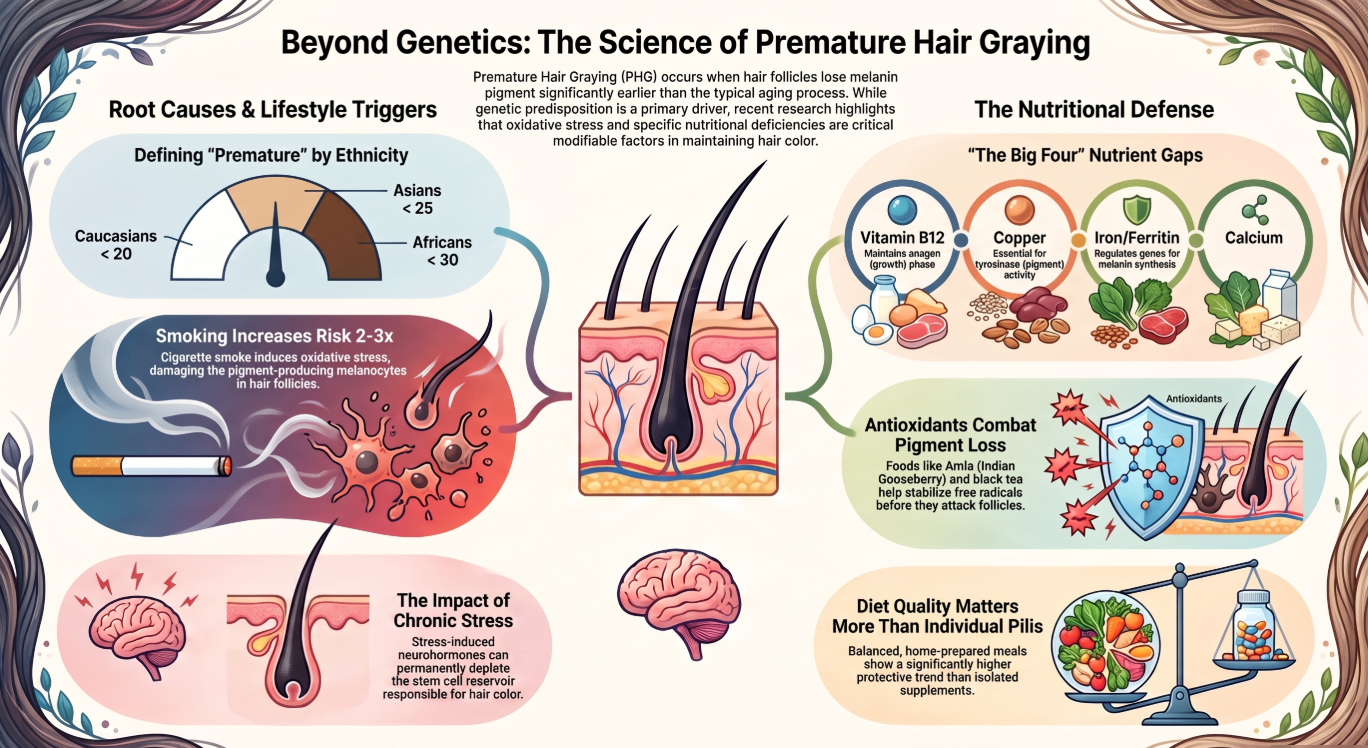
Medical literature commonly defines premature graying as hair turning grey before age 20 in people of Caucasian ancestry, before age 25 in people of Asian ancestry, and before age 30 in people of African ancestry.
For Asian populations, including Malaysians, white hair appearing before the mid-20s may therefore be considered earlier than expected.
However, these age limits should not be treated as absolute rules.
Someone may develop white hair relatively early simply because it runs strongly in their family. Conversely, rapid or unusual changes may deserve medical assessment, particularly when other symptoms are present.
Consequently, the important question is not only “How old am I?” but also “Why is my hair changing, and are there any other factors involved?”
How Does Hair Get Its Natural Colour?
To understand white hair, it helps to understand how hair colour is produced.
Your hair follicles contain melanocytes. These cells produce melanin during the growth of the hair.
Two major types of melanin contribute to natural hair colour.
Eumelanin mainly contributes to brown and black shades. Meanwhile, pheomelanin contributes more to yellow and reddish tones.
The combination and quantity of these pigments create the enormous variety of natural hair colours seen in humans.
However, pigment production depends on a functioning population of pigment-producing cells and their supporting stem cells.
Research has shown that melanocyte stem cells play an important role in maintaining hair pigmentation. When these cells become depleted or fail to function properly, newly growing hair can lose its colour.
As a result, the hair that grows from the affected follicle may appear grey or white.
The Biggest Cause of White Hair: Genetics
If your parents developed white hair or grey hair early, you may have a higher chance of experiencing the same pattern.
Genetic factors are among the most consistently recognised influences on premature graying. Research has found a strong association between early graying and a family history of premature graying.
In simple terms, your genes can influence how long your hair follicles maintain effective pigment production.
That explains why some people start noticing white hair in their twenties while others maintain their natural colour much longer.
However, genetics is not necessarily the entire story.
Environmental factors, lifestyle, nutrition and certain health conditions may also influence the timing or progression of graying.
Therefore, having a genetic tendency does not mean there is nothing you can do for your overall hair health.
Can Stress Cause White Hair?
“Too much stress will turn your hair white.”
You may have heard this many times.
Interestingly, scientific research has identified biological mechanisms that could explain a relationship between significant stress and hair pigmentation.
Studies have shown that stress-related activation of the sympathetic nervous system can affect melanocyte stem cells in hair follicles. In experimental research, this process was associated with depletion of these pigment-producing stem cells.
However, this does not mean that every stressful period will automatically cause white hair.
Hair graying is a complex process. Genetics, age and other biological factors remain important.
Therefore, it would be inaccurate to blame every white hair on stress.
Nevertheless, managing chronic stress remains beneficial for your overall health. Getting adequate sleep, exercising regularly, maintaining social connections and making time for recovery can all support general wellbeing.
So, while stress is not the only explanation for white hair, taking care of your stress levels is still a sensible part of a healthy lifestyle.
White Hair and Oxidative Stress
Another important area of research involves oxidative stress.
Your cells naturally produce reactive molecules called reactive oxygen species, or ROS. Normally, the body’s antioxidant systems help maintain a balance.
When oxidative processes become excessive, however, cellular structures can be damaged.
Hair follicles are highly active structures. They require substantial cellular activity to produce new hair.
Research has suggested that oxidative stress may contribute to melanocyte dysfunction and premature hair graying.
This is one reason researchers have investigated the relationship between smoking, inflammation, oxidative stress and premature graying.
Nevertheless, oxidative stress should not be viewed as a simple explanation for every case of white hair.
There is also no single antioxidant supplement that has been proven to reliably restore natural hair colour in everyone.
Instead, the more sensible approach is to support overall health and address specific risk factors where appropriate.
Can Vitamin B12 Deficiency Cause White Hair?
Vitamin B12 is important for normal DNA synthesis, cell division and neurological function.
Several studies have reported an association between premature graying and vitamin B12 deficiency. Other nutritional deficiencies have also been investigated in people with early hair graying.
However, this does not mean that everyone with white hair is deficient in vitamin B12.
Your risk may be higher if you have dietary restrictions, certain gastrointestinal conditions, problems with absorption or other risk factors.
Therefore, taking vitamin B12 simply because you have white hair is not necessarily the right approach.
Instead, if your medical history suggests a possible deficiency, your doctor can decide whether testing is appropriate.
When a genuine deficiency is identified, correcting it is important for your overall health and may potentially help with pigment changes in some individuals.
What About Vitamin D, Iron, Zinc and Copper?
Researchers have also investigated several other nutrients in relation to premature graying.
These include vitamin D, iron, ferritin, calcium, zinc and copper.
Some studies have reported associations between premature graying and lower levels of certain nutrients. However, these findings do not prove that every person with white hair has a nutritional deficiency.
Copper is particularly interesting because it participates in biological processes involved in melanin production.
Iron also plays important roles in many physiological processes, including oxygen transport and cellular function.
Nevertheless, this does not mean you should start taking iron or copper supplements without medical advice.
Too much of certain nutrients can also cause harm.
Therefore, the safest principle is simple:
Identify a genuine deficiency before treating it.
A balanced diet should remain the foundation. If your history or symptoms suggest a nutritional problem, appropriate testing can help determine what needs attention.
Smoking and White Hair
Smoking affects much more than your lungs.
Cigarette smoke contains substances that can increase oxidative stress and damage cells. Research has also reported an association between smoking and premature hair graying.
Smoking may therefore contribute to an environment that is less favourable for healthy hair follicles.
However, the effects of smoking extend far beyond hair colour.
Smoking increases the risk of cardiovascular disease, respiratory disease and several cancers. Consequently, quitting smoking is one of the most valuable lifestyle changes you can make for your health.
If you smoke and have noticed premature white hair, quitting is a much more meaningful step than simply searching for another hair supplement.
Your hair may be one of the things you notice. Your heart, lungs and blood vessels are the much bigger reason to quit.
Can Scalp Problems Cause White Hair?
Your scalp provides the environment in which your hair follicles grow.
Conditions such as dandruff, dermatitis and inflammation can affect scalp comfort and hair quality. However, they should not automatically be blamed for causing white hair.
The biological process of graying mainly involves changes in the pigment-producing system of the hair follicle.
Therefore, using an expensive shampoo will not necessarily prevent premature graying.
Likewise, switching to an “organic” shampoo has not been proven to reverse genetically determined white hair.
Nevertheless, gentle scalp care remains important.
Choose hair products that suit your scalp. Avoid unnecessary irritation. If you experience persistent itching, scaling, redness or significant hair loss, consider having your scalp assessed by a medical professional.
Do Hair Dyes Cause White Hair?
Hair dye and bleaching can change the appearance and condition of your hair.
Bleaching products, in particular, use chemicals that remove natural pigment from the existing hair shaft.
However, this is different from the biological process that causes new hair to grow without pigment.
In other words, bleaching your hair does not necessarily mean that your follicles have started producing white hair.
Frequent chemical treatments can nevertheless damage the hair shaft and make hair dry, brittle or prone to breakage.
Therefore, if your hair is already fragile, it is sensible to reduce unnecessary chemical processing and excessive heat styling.
Can White Hair Be a Sign of a Health Condition?
Most cases of grey or white hair are not caused by a serious disease.
However, premature graying has been associated with certain medical conditions in some individuals.
These include certain thyroid disorders, autoimmune conditions and nutritional deficiencies.
For example, vitiligo causes loss of skin pigmentation. When pigment cells are affected in areas containing hair, the hair can also lose its colour.
Certain hair and immune disorders may also affect pigmentation.
However, having white hair does not mean that you have an autoimmune disease.
Instead, your doctor should consider the entire clinical picture.
If your hair turns white unusually early, changes rapidly or appears alongside other symptoms, a medical assessment may help determine whether further investigation is appropriate.
White Hair and Heart Health
You may have seen claims online that premature white hair is a direct warning sign of heart disease.
The reality is more complicated.
Some research has reported associations between premature graying and cardiovascular risk factors. However, the evidence does not establish that white hair itself can diagnose heart disease.
Therefore, you should not panic if you notice several white hairs.
Instead, consider your overall cardiovascular health.
If you smoke, have high blood pressure, abnormal cholesterol, diabetes, excess abdominal weight or a strong family history of cardiovascular disease, these factors deserve attention regardless of your hair colour.
Your hair should never replace proper cardiovascular screening.
Can White Hair Turn Black Again?
This is probably the most common question people ask.
Unfortunately, there is no universally proven treatment that reliably turns all established white hair back to its original colour.
However, the answer is not always completely black and white.
In some situations, hair pigmentation may return when an underlying factor is identified and treated. Researchers have also documented examples of spontaneous repigmentation under certain circumstances.
Nevertheless, these situations should not create unrealistic expectations.
If your white hair is primarily related to age or genetic factors, reversing it completely may not be possible with current treatments.
Therefore, be cautious about products that promise to make all white hair disappear within days or weeks.
A responsible medical approach should explain what is known, what is uncertain and what results are realistically possible.
What Is Greyverse?
One ingredient that has attracted interest in the field of hair pigmentation is palmitoyl tetrapeptide-20.
This peptide has been studied for its potential effects on melanogenesis and pathways involved in hair pigmentation.
A published case report described the use of a Greyverse formulation containing palmitoyl tetrapeptide-20 in a young woman with premature graying. The report described increased hair pigmentation after several months of use.
This is interesting research.
However, there is an important distinction between a promising treatment and a proven treatment.
A case report involves a very small number of people. Therefore, it cannot establish that the same results will occur in everyone.
Recent reviews continue to note that effective, evidence-based treatments for premature graying remain limited.
Consequently, products containing pigmentation-related peptides may be discussed as potential options, but they should not be presented as a guaranteed cure for white hair.
Can Supplements Remove White Hair?
Supplements can be useful when they correct a genuine nutritional deficiency.
They are not, however, a universal treatment for white hair.
Taking large amounts of biotin, zinc, copper, iron or other nutrients without a demonstrated need may not provide the result you want.
In some cases, excessive supplementation can also cause health problems.
Therefore, avoid the temptation to take multiple “hair vitamins” simply because your hair is turning white.
Instead, focus on a balanced diet.
Eat a variety of vegetables, fruits, whole grains, legumes, nuts and appropriate sources of protein. If your diet or medical history suggests a possible nutritional deficiency, discuss this with your doctor.
The goal is not to take more supplements.
The goal is to provide your body with what it actually needs.
How to Look After Hair With White Hair
Although you cannot change your genes, you can still improve your overall hair-care habits.
Start with gentle hair care.
Choose products that suit your scalp and avoid unnecessary irritation. If your hair is dry or fragile, reduce excessive heat from hair dryers, straighteners and curling tools.
Next, consider reducing frequent bleaching or aggressive chemical treatments.
These treatments can damage the hair shaft even though they are not necessarily the primary cause of biological graying.
Sun protection is also sensible, particularly if you spend long periods outdoors. Wearing a hat can reduce direct exposure to sunlight on your scalp and hair.
Finally, pay attention to your general lifestyle.
Get adequate sleep. Exercise regularly. Eat a balanced diet. Avoid smoking.
These habits cannot guarantee that your hair will remain black.
Nevertheless, they support your overall health and provide a healthier environment for your hair and scalp.
Should You Pull Out White Hair?
You may be tempted to pull out every white hair you see.
You do not need to.
Pulling out one white hair does not cause the surrounding hairs to turn white. Each hair follicle operates independently.
However, repeatedly plucking hairs can irritate or damage the follicle.
More importantly, plucking does not address the reason the hair became white in the first place.
If you do not like the appearance of white hair, trimming, colouring or professionally selected cosmetic options may be more practical.
When Should You See a Doctor About White Hair?
A few white hairs are usually not a medical emergency.
However, an assessment may be worthwhile when white hair appears unusually early, progresses rapidly or occurs together with other changes.
Consider speaking with a doctor if you notice:
- White hair at a very young age.
- Rapid changes in hair pigmentation.
- Significant hair loss.
- Areas of skin losing pigmentation.
- Persistent fatigue or other unexplained symptoms.
- Unexpected changes in body weight.
- Symptoms that could suggest a thyroid problem.
- A possible nutritional deficiency.
- Other significant changes in your general health.
Your doctor can then decide whether further investigation is appropriate.
Importantly, not everyone needs extensive blood testing.
Medical tests should be selected according to your history, symptoms and clinical assessment.
How Interclinic Can Help With White Hair
At Interclinic Medicine & Surgery Clinic, we believe that treating hair concerns starts with understanding the person behind the problem.
When you come for an assessment of white hair, we can consider several factors.
These may include your age, family history, when your hair first started turning white, how quickly the change is occurring, your diet, lifestyle, scalp condition and relevant medical history.
When clinically appropriate, your doctor may recommend specific investigations.
Depending on your individual situation, these may include tests related to nutritional status, thyroid function or other potential contributing factors.
This approach helps us avoid treating every case of white hair in exactly the same way.
For some people, genetics may be the main explanation.
For others, an underlying nutritional or medical issue may deserve attention.
Once the relevant factors have been assessed, your doctor can discuss realistic options for managing your hair and scalp.
The goal is not to promise something that medicine cannot guarantee.
Instead, we aim to help you understand why your hair is changing and what can realistically be done about it.
White Hair Does Not Always Mean Something Is Wrong
Seeing your first white hair can be unsettling.
However, it does not automatically mean that you are unhealthy or that you are suddenly “aging too quickly”.
Genetics remains one of the most important influences on when hair begins to lose its pigment. At the same time, research continues to investigate the roles of oxidative stress, smoking, nutritional deficiencies, stress and certain medical conditions.
The key is to separate scientific evidence from marketing claims.
There is currently no magic shampoo, supplement or treatment that can guarantee the complete reversal of white hair.
Nevertheless, identifying and correcting an underlying problem may be helpful in selected individuals. Meanwhile, emerging treatments involving pigmentation-related peptides remain an area of ongoing research.
Therefore, the best approach is individualised.
Understand the cause. Address factors that can be changed. Maintain good scalp and general health. Then consider cosmetic or medical options according to your needs.
Book a White Hair Consultation at Interclinic
If you are concerned about white hair, you do not have to guess what is causing it.
At Interclinic Medicine & Surgery Clinic, our doctors can assess your hair concerns from a medical and holistic perspective.
We can help you understand whether your premature white hair is likely to be related to family genetics, lifestyle, nutritional factors or another health concern.
More importantly, we can help you set realistic expectations about treatment.
White hair is not simply about appearance. It is part of the complex biology of the hair follicle and its pigment-producing cells.
For many people, it is a normal part of ageing or their genetic pattern. For others, early graying may justify a closer look at their overall health.
So, if you have noticed white hair at a young age, especially if it is appearing rapidly or together with other symptoms, consider getting a professional assessment.
Understanding the cause is the first step.
From there, you can make a more informed decision about what to do next.
Interclinic Medicine & Surgery Clinic
No. 7, Jalan USJ 21/10, USJ 21
Subang Jaya, Selangor, Malaysia
Phone: 018-3525359
Website: theinterclinic.com